Fibre
Psyllium husk
Psyllium husk is the outer seed coat of Plantago ovata. It contains soluble, water-binding dietary fibre and forms a gel when mixed with water.
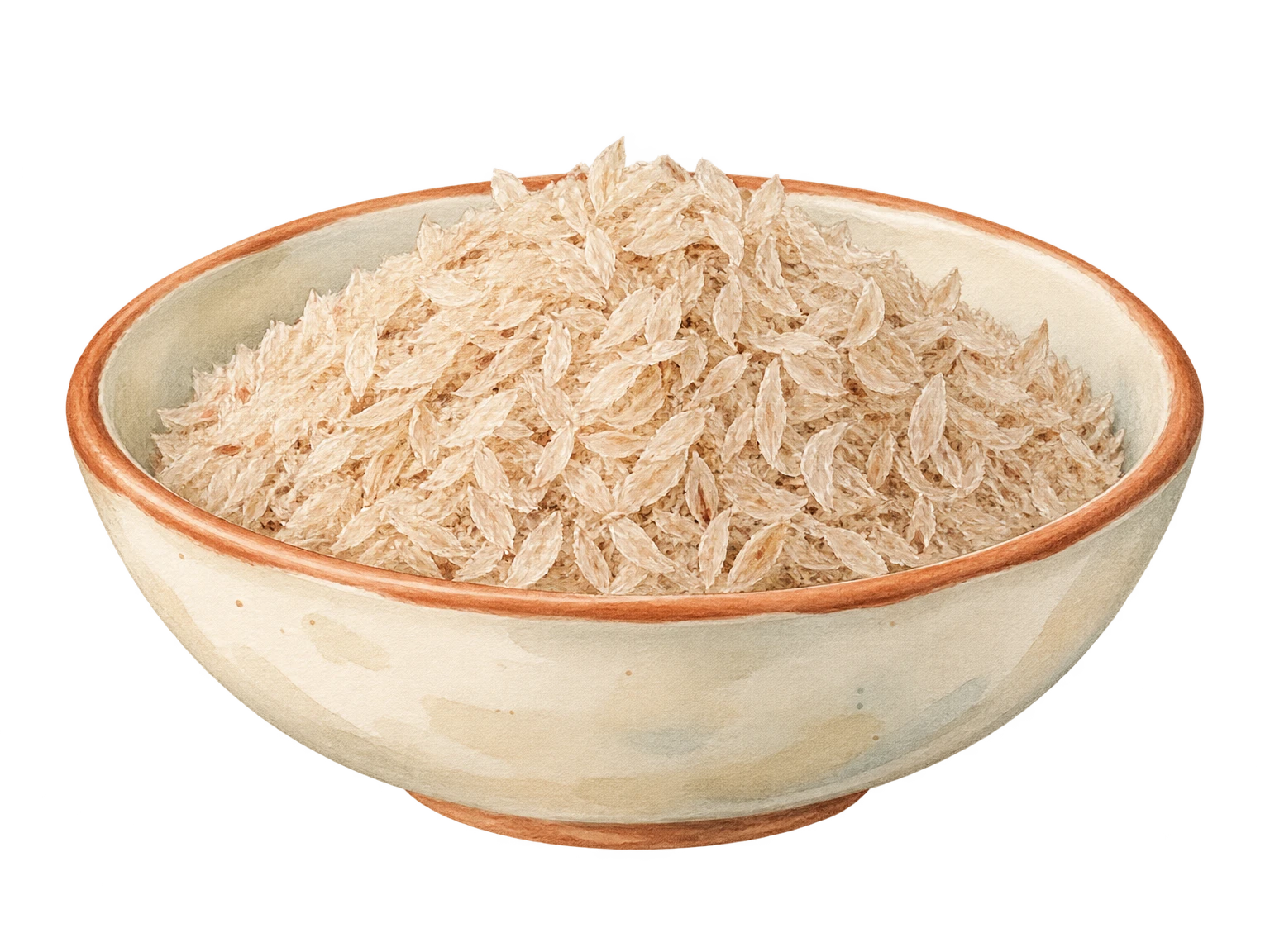
Psyllium husk is separated from the seeds of Plantago ovata and used as husk fragments or milled powder. It is a plant-derived fibre ingredient, not the same as whole psyllium seeds. Its mucilage binds water and swells to form a gel. Follow the product’s preparation instructions and take it with sufficient fluid—never swallow it dry. Do not take it if you have difficulty swallowing.
Psyllium husk: water-binding fibre
Psyllium husk is the outer seed coat of Plantago ovata. It is available as husk fragments or milled powder and is not the same as whole psyllium seeds. Its soluble dietary fibre binds water, causing the husks to swell and form a gel-like mass.
How can it support bowel movements?
In adults with chronic constipation, psyllium husk can soften stools and support more regular bowel movements. Water retention and gel formation increase stool bulk. The evidence is moderate: a systematic review found a higher response rate than control in three psyllium trials. Different definitions of improvement and possible trial bias limit certainty.
EMA recognises psyllium husk as a herbal medicine. This is not the same as EU authorisation of a food health claim.
Use in the kitchen
Psyllium husk is also used in gluten-free baking to improve dough structure and texture. This is a technological use, not a health benefit claim. Results depend on the recipe and processing.
Side effects and medicines
Wind and bloating can occur, especially when starting, and often improve after a few days. If they persist or are troublesome, ask a pharmacist or doctor. Do not dismiss new or substantial abdominal pain as normal adjustment. Avoid inhaling powder dust, as this can lead to allergic sensitisation. Do not use the product if you have a known allergy to psyllium husk or another ingredient. Sudden mouth or throat swelling, breathing difficulty or collapse require emergency help.
Psyllium husk may delay the absorption of some oral medicines. Before starting, ask a pharmacist about the appropriate interval between doses. Medical supervision is needed if you use thyroid hormones, diabetes medicines including insulin, or medicines that slow the bowel, such as opioids. Do not change prescribed medicine doses yourself.
When to seek advice before use
Age restrictions for children vary by indication and product. During pregnancy and breastfeeding, psyllium husk can be considered when needed if dietary changes are insufficient, but pregnancy data are limited. Seek advice about its use. Medical supervision is recommended for older or debilitated people. If heart or kidney disease means you must restrict fluids, also seek medical advice before starting.
How nutrition works
Bowel regularity
Glycaemic control
Psyllium husk may reduce fasting blood glucose and HbA1c in adults with type 2 diabetes. [3]
Blood pressure
Psyllium husk may slightly reduce systolic blood pressure in adults; a clear effect on diastolic blood pressure has not been demonstrated. [4]
Body weight
Psyllium husk has not been shown to produce dependable weight loss in adults. [5]
Statements & evidence
Psyllium husk is the seed coat of Plantago ovata, rather than the whole seed. [6]
They are available as husks or powdered husks. Whole psyllium seeds and psyllium husks are different ingredients.
The dietary fibre in psyllium husk binds water and forms a gel-like mass. [6]
Psyllium husk swells when mixed with water. This describes an ingredient property, not an authorised health claim.
Psyllium husk is used in gluten-free baking to improve dough structure and texture. [7]
This is a technological use, not a health benefit claim. Results depend on the recipe and processing.
Psyllium husk must be taken with sufficient liquid. Too little liquid can cause choking or blockage of the oesophagus or bowel. [2]
Do not swallow them dry, and follow the product’s preparation and fluid instructions. EMA specifies this precaution for psyllium husk used as a herbal medicine.
Psyllium husk is unsuitable for oral use in people with swallowing difficulties, throat problems, or gastrointestinal narrowing or obstruction. [2]
EMA lists these contraindications for use as a herbal medicine. If they apply to you, do not self-administer psyllium husk.
Psyllium husk may delay the absorption of some oral medicines. [2]
Ask a pharmacist about the appropriate timing for your medicines. EMA recommends separating doses and medical supervision when psyllium husk is used with thyroid hormones.
Psyllium husk can cause flatulence and abdominal bloating. Allergic reactions are also possible. [6][2]
Avoid inhaling the powder, as this can lead to allergic sensitisation. These precautions come from EMA’s assessment of herbal medicines.
Safety information
Caution
Always take with enough liquid
Psyllium husk swells. With too little liquid, it can block the throat, oesophagus or bowel. Never swallow the powder dry, follow your product’s liquid instructions and do not take it immediately before bed. Chest pain, vomiting, difficulty swallowing or breathing after a dose require immediate medical help. [8][9]
Contraindication
Do not use with a known allergy
Do not use psyllium husk if you are allergic to it or another product ingredient. Allergic reactions can follow ingestion, skin contact or inhalation of powder. Sudden mouth or throat swelling, breathing difficulty or collapse require emergency help. The frequency of severe reactions is not reliably known. [8][9]
Contraindication
Do not use with swallowing problems or bowel obstruction
Do not take psyllium husk with swallowing or throat problems, narrowing of the digestive tract, certain oesophageal conditions, known or suspected bowel obstruction, intestinal paralysis or megacolon. Faecal impaction or abdominal pain with nausea or vomiting requires medical assessment before use. [8]
Caution
Have persistent symptoms assessed
Do not self-treat with psyllium husk if a sudden change in bowel habits lasts more than two weeks, you have unexplained rectal bleeding, or you cannot pass stool after using a laxative. If constipation persists after three days of treatment, seek advice from a doctor or pharmacist. [8]
Interaction
Check spacing from other medicines
If you take medicines, ask a pharmacist about the appropriate interval before starting. Psyllium husk may delay absorption of medicines including lithium, carbamazepine, digoxin and coumarin anticoagulants; minerals and vitamin B12 are also listed in the product information. A short general interval must not replace medicine-specific instructions. [11][12]
Interaction
Review thyroid and diabetes medicines
If you use thyroid hormones such as levothyroxine or diabetes medicines including insulin, take psyllium husk under medical supervision. Treatment may need adjustment. If you have diabetes, also discuss glucose monitoring and do not change prescribed doses yourself. [8]
Interaction
Seek advice with medicines that slow the bowel
If you take opioids or other medicines that inhibit bowel movement, use psyllium husk only under medical supervision: the combination can increase concern about bowel blockage. Follow any stricter restrictions in your product leaflet. [8]
Upper level · Adults
No established psyllium-specific upper limit
No EFSA psyllium-specific tolerable upper intake level was found in the authoritative sources reviewed. This does not mean unlimited amounts are safe. EFSA’s adequate intake of 25 g fibre per day for adults concerns total dietary fibre, not a psyllium dose or safety ceiling. Follow your product’s dosing instructions. [13][8]
Caution
Age restrictions apply to children
EMA does not recommend psyllium husk for constipation in children under six, or for indications involving increased fibre intake in children under twelve. This reflects insufficient efficacy data, not demonstrated toxicity. Do not give it to young children without medical advice, and follow the product’s age restrictions. [8]
Caution
Pregnancy and breastfeeding: use when needed
During pregnancy and breastfeeding, psyllium husk can be considered when needed if dietary changes are insufficient. Discuss use with your midwife, doctor or pharmacist. Pregnancy data are limited; acceptance of use does not mean extensive safety studies are available. [8]
Caution
Seek advice if your fluid intake is restricted
If heart or kidney disease means you must restrict fluids, seek medical advice before use: psyllium husk needs enough liquid. Do not independently reduce the liquid required for a dose. Other product ingredients may also matter with these conditions. [12][8]
Caution
Medical supervision for older or debilitated people
EMA recommends medically supervised use for older or debilitated people. Safe swallowing, adequate liquid and other medicines should be considered. [8]
Caution
Avoid inhaling powder dust
Avoid creating dust when measuring and mixing, and do not inhale the powder. This is particularly important for healthcare workers or carers who prepare it repeatedly, and people with atopy: repeated inhalation can cause allergic sensitisation. [8]
Caution
Check the formulation with phenylketonuria
If you have phenylketonuria, check the ingredients and leaflet: some psyllium products contain aspartame, a source of phenylalanine. This restriction concerns the particular formulation, not pure psyllium husk in general. [14]
Frequently asked questions
What is psyllium husk, and is it the same as whole psyllium seeds?
Psyllium husk is the outer seed coat of Plantago ovata, not the whole seed. Its water-binding dietary fibre swells and forms a gel when mixed with water.
Can psyllium husk help with constipation?
Psyllium husk can soften stools and support more regular bowel movements in adults with chronic constipation; the evidence is moderate. If constipation persists after three days of use, seek advice from a doctor or pharmacist.
How do I take psyllium husk safely?
Follow your product’s dosing, preparation and fluid instructions, and never swallow psyllium husk dry or take it immediately before bed. Too little liquid can cause blockage of the throat, oesophagus or bowel. Do not take it if you have difficulty swallowing or a known or suspected bowel obstruction.
What side effects can psyllium husk cause?
Wind and bloating can occur, especially when starting, and often improve after a few days. Allergic reactions are also possible, so avoid inhaling the powder. Sudden mouth or throat swelling, breathing difficulty or collapse require emergency help.
Can I take psyllium husk with medicines?
Psyllium husk may delay the absorption of some oral medicines. Ask a pharmacist about the appropriate interval for your medicines before starting. Medical supervision is needed if you use thyroid hormones, diabetes medicines or medicines that slow the bowel, such as opioids.
Related articles

MyFoodPath is live – and why this project exists
After a long preparation, MyFoodPath goes live: a knowledge base showing what foods and nutrients have been scientifically shown to do – and what they have not.
Eating more fibre: step by step
How to increase your fibre intake slowly and practically – with whole grains, fruit and, if you like, psyllium husk.
Sources
- 01The American Journal of Clinical Nutrition · 2022The Effect of Fiber Supplementation on Chronic Constipation in Adults: An Updated Systematic Review and Meta-Analysis of Randomized Controlled Trialsvan der Schoot A, Drysdale C, Whelan K, Dimidi EDOI 10.1093/ajcn/nqac184PubMed 35816465
- 02European Medicines AgencyCommunity herbal monograph on Plantago ovata Forssk., seminis tegumentumOpen source
- 032020The effect of psyllium consumption on weight, body mass index, lipid profile, and glucose metabolism in diabetic patients: A systematic review and dose-response meta-analysis of randomized controlled trialsPubMed 31919936Open source
- 04Food Science & Nutrition · 2024The effect of psyllium consumption on blood pressure: Systematic review and dose–response meta-analysis of randomized controlled trialsDOI 10.1002/fsn3.3863
- 052019The effects of psyllium supplementation on body weight, body mass index and waist circumference in adults: A systematic review and dose-response meta-analysis of randomized controlled trialsPubMed 30880409Open source
- 06European Medicines AgencyPlantaginis ovatae seminis tegumentum — herbal medicinal productOpen source
- 07ANSES · 2023Vigil’Anses No. 19 — June 2023: PsylliumOpen source
- 08European Medicines Agency, Committee on Herbal Medicinal Products · 2013Community herbal monograph on Plantago ovata Forssk., seminis tegumentumOpen source
- 09Health Canada · 2024Psyllium monographOpen source
- 10NHSSide effects of FybogelOpen source
- 11NHSTaking Fybogel with other medicines and herbal supplementsOpen source
- 12MedlinePlus, US National Library of MedicinePsyllium: MedlinePlus Drug InformationOpen source
- 13EFSA Journal · 2010Scientific Opinion on Dietary Reference Values for carbohydrates and dietary fibreDOI 10.2903/j.efsa.2010.1462
- 14NHSWho can and cannot take FybogelOpen source
- 15European Food Safety AuthorityArticle 13 health-claim reference list including Plantago ovata/ispaghula and cholesterol, ID 2106Open source
- 16European Commission · 2012Commission Regulation (EU) No 432/2012 establishing a list of permitted health claims made on foods, other than those referring to the reduction of disease risk and to children's development and healthOpen source
- 17European Food Safety Authority · 2017Dietary Reference Values for nutrients: Summary reportOpen source
- 182018Effect of psyllium (Plantago ovata) fiber on LDL cholesterol and alternative lipid targets, non-HDL cholesterol and apolipoprotein B: a systematic review and meta-analysis of randomized controlled trialsPubMed 30239559Open source
- 192026Fiber Supplementation in Irritable Bowel Syndrome: A Systematic Review and Meta-Analysis of Randomized Controlled TrialsPubMed 42600900Open source
- 20European Food Safety AuthorityHealth claims (art. 13)Open source
- 21European Medicines Agency – Committee on Herbal Medicinal Products (HMPC) · 2013Ispaghula husk (Plantago ovata Forssk., seminis tegumentum) – Herbal medicine: summary for the public (EMA/HMPC/313600/2013)Open source
- 22European Parliament and Council of the European Union · 2011Regulation (EU) No 1169/2011 on the provision of food information to consumersOpen source
- 23EFSA Journal · 2021Safety and efficacy of a feed additive consisting of the seed husk of Plantago ovata Forssk. for use in cats and dogs (C.I.A.M.)DOI 10.2903/j.efsa.2021.6445
- 242014The effect of fiber supplementation on irritable bowel syndrome: a systematic review and meta-analysisPubMed 25070054Open source
- 25BMC Endocrine Disorders · 2024The effect of psyllium on fasting blood sugar, HbA1c, HOMA IR, and insulin control: a GRADE-assessed systematic review and meta-analysis of randomized controlled trialsDOI 10.1186/s12902-024-01608-2