Legumes
Lentils
Lentils are small, lens-shaped seeds belonging to the pulse family. They are eaten cooked and are particularly known for their plant protein and fibre.
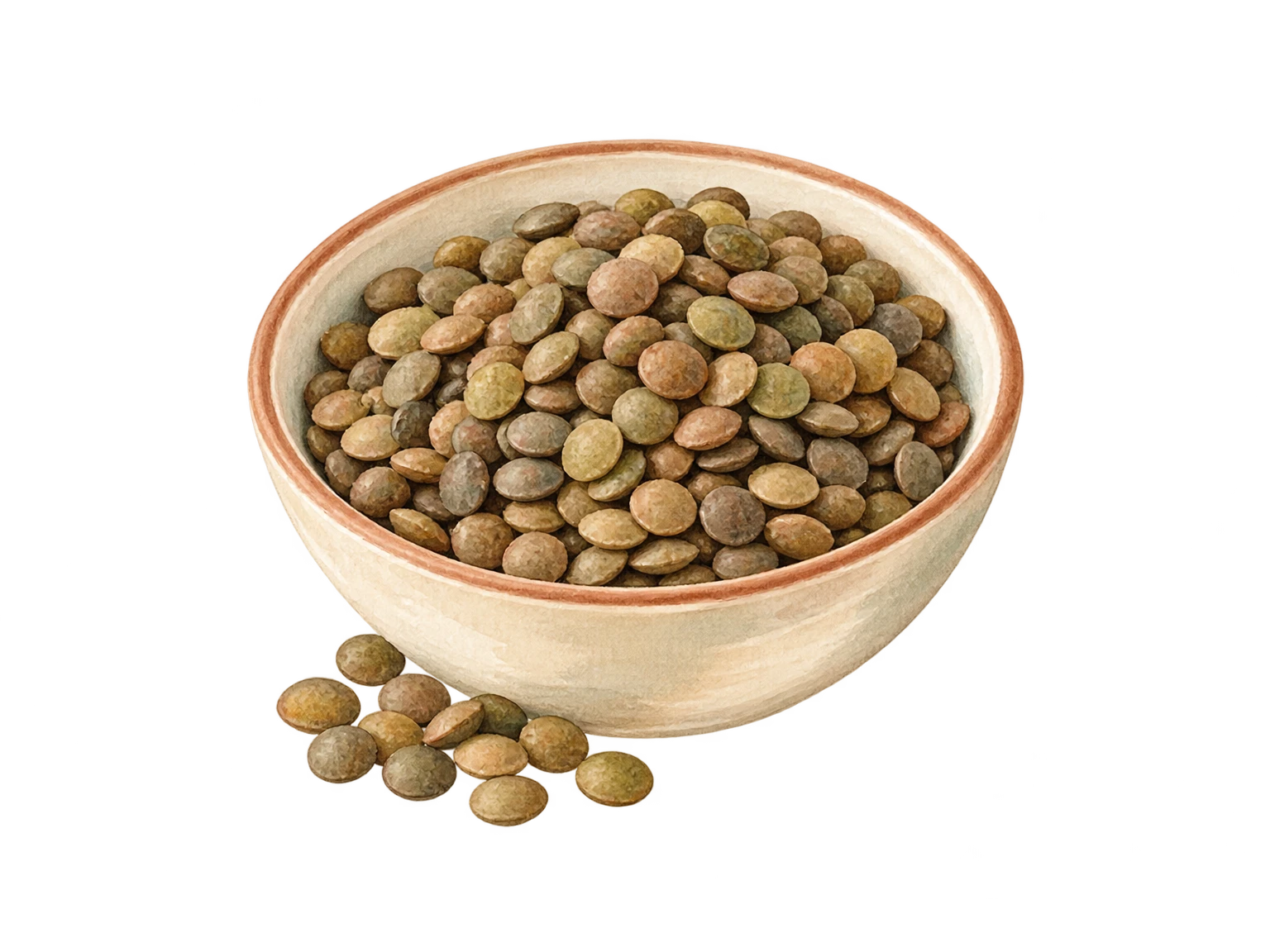
Lentils come in different colours and sizes, including brown, green and red varieties. You can use them in soups, stews, salads and purées; depending on the variety, they soften or hold their shape during cooking. They provide protein, carbohydrates and fibre, among other nutrients. Nutrient amounts are listed per 100 g in the composition table, together with the source.
What are lentils?
Lentils are the seeds of a pulse. They come in different colours and sizes, including brown, green and red varieties.
How to use lentils
Lentils are eaten cooked and can be used in soups, stews, salads and purées. Depending on the variety, they may soften during cooking or hold their shape. They provide protein, carbohydrates and fibre, among other nutrients. The nutrient amounts are shown in the nutrition table per 100 g.
Lentils can cause gas. If you are sensitive to pulses, try smaller portions to see how you tolerate them. With irritable bowel syndrome, fermentable carbohydrates in lentils may worsen symptoms; small portions of tinned lentils may be better tolerated.
Nutrients
- Dietary fibre16.3 gper 100 g[11]
- Calcium63.7 mgper 100 g[11]
- Iron6.31 mgper 100 g[11]
- Magnesium96.8 mgper 100 g[11]
- Phosphorus478 mgper 100 g[11]
- Potassium937 mgper 100 g[11]
- Zinc3.4 mgper 100 g[11]
- Copper0.6 mgper 100 g[11]
- Selenium10.5 µgper 100 g[11]
- Vitamin A3.05 µgper 100 g[11]
- Vitamin C1.61 mgper 100 g[11]
- Vitamin B60.35 mgper 100 g[11]
- Vitamin K11.9 µgper 100 g[11]
- Folate117 µgper 100 g[11]
Safety information
Side effect
Gas and bloating in sensitive digestion
Lentils can cause gas and bloating, particularly if you are sensitive to pulses. Try smaller portions to assess your tolerance. Gas alone does not mean you have an allergy. [1]
Caution
Consider portion size with IBS
If you have irritable bowel syndrome, fermentable carbohydrates in lentils may worsen your symptoms. Small portions of tinned lentils may be better tolerated. Low-FODMAP portion guidance is for symptom management, not a safety limit. [2]
Contraindication
Avoid lentils with a confirmed lentil allergy
If you have a confirmed lentil allergy, avoid lentils. Reactions can be severe; cooking does not reliably remove their allergenicity. Seek emergency medical help immediately for breathing difficulty, throat swelling or faintness after eating. [5][6][7]
Caution
Assess other pulse allergies individually
If you are allergic to another pulse, reactions to lentils are possible too. This does not mean you must automatically avoid all pulses. Seek an individual allergy assessment; a positive test alone does not establish a clinical lentil allergy. [5]
Caution
Plan individually if potassium restriction is prescribed
If you have kidney disease or raised blood potassium, match lentil portions to your prescribed potassium and protein targets. Lentils are not prohibited in every case of kidney disease; your blood results and individual dietary plan matter. [8][9]
Interaction
Consider potassium with certain medicines
ACE inhibitors, angiotensin-receptor blockers and potassium-sparing diuretics can raise blood potassium, especially with impaired kidney function. If you have consequently been prescribed potassium restriction, seek advice on suitable lentil portions. This is not a specific lentil–medicine interaction or a reason for blanket avoidance. [8]
Upper level
No established daily upper intake limit
No lentil-specific maximum safe daily amount was identified in the sources reviewed. EFSA upper limits for individual nutrients are not portion limits for lentils. The absence of a limit does not mean unlimited intake is safe. [10]
Frequently asked questions
What are lentils?
Lentils are small, lens-shaped seeds from the pulse family.
How are lentils eaten?
Lentils are eaten cooked.
What are lentils known for?
Lentils are particularly known for their plant protein and fibre.
Sources
- 01National Institute of Diabetes and Digestive and Kidney DiseasesEating, Diet, & Nutrition for Gas in the Digestive TractOpen source
- 02Cambridge University Hospitals NHS Foundation TrustLow FODMAP diet: Reducing fermentable carbohydrates in your dietOpen source
- 03Bundesinstitut für RisikobewertungKrank durch Lektine in Pflanzenkost?Open source
- 04EFSA Journal · 2026Risks for human health related to the presence of plant lectins in foodDOI 10.2903/j.efsa.2026.9850
- 05Legume Allergens Pea, Chickpea, Lentil, Lupine and BeyondOpen source
- 06Adult and Pediatric Food Allergy to Chickpea, Pea, Lentil, and Lupine: A Scoping ReviewDOI 10.1016/j.jaip.2020.10.046PubMed 33166732
- 07European Food Safety AuthorityFood allergensOpen source
- 08National Institutes of Health, Office of Dietary SupplementsPotassium - Health Professional Fact SheetOpen source
- 09National Institute of Diabetes and Digestive and Kidney DiseasesHealthy Eating for Adults with Chronic Kidney DiseaseOpen source
- 10European Food Safety AuthorityTolerable upper intake levelOpen source
- 11ANSES – French Agency for Food, Environmental and Occupational Health & Safety – Ciqual French food composition table · 2025Lentil, dried (average) (CIQUAL 20359)Open source