Fish
Salmon
Salmon is an oily fish with flesh that is usually pink to orange. Known for its protein and omega-3 fatty acids, it is commonly eaten baked, grilled or smoked.
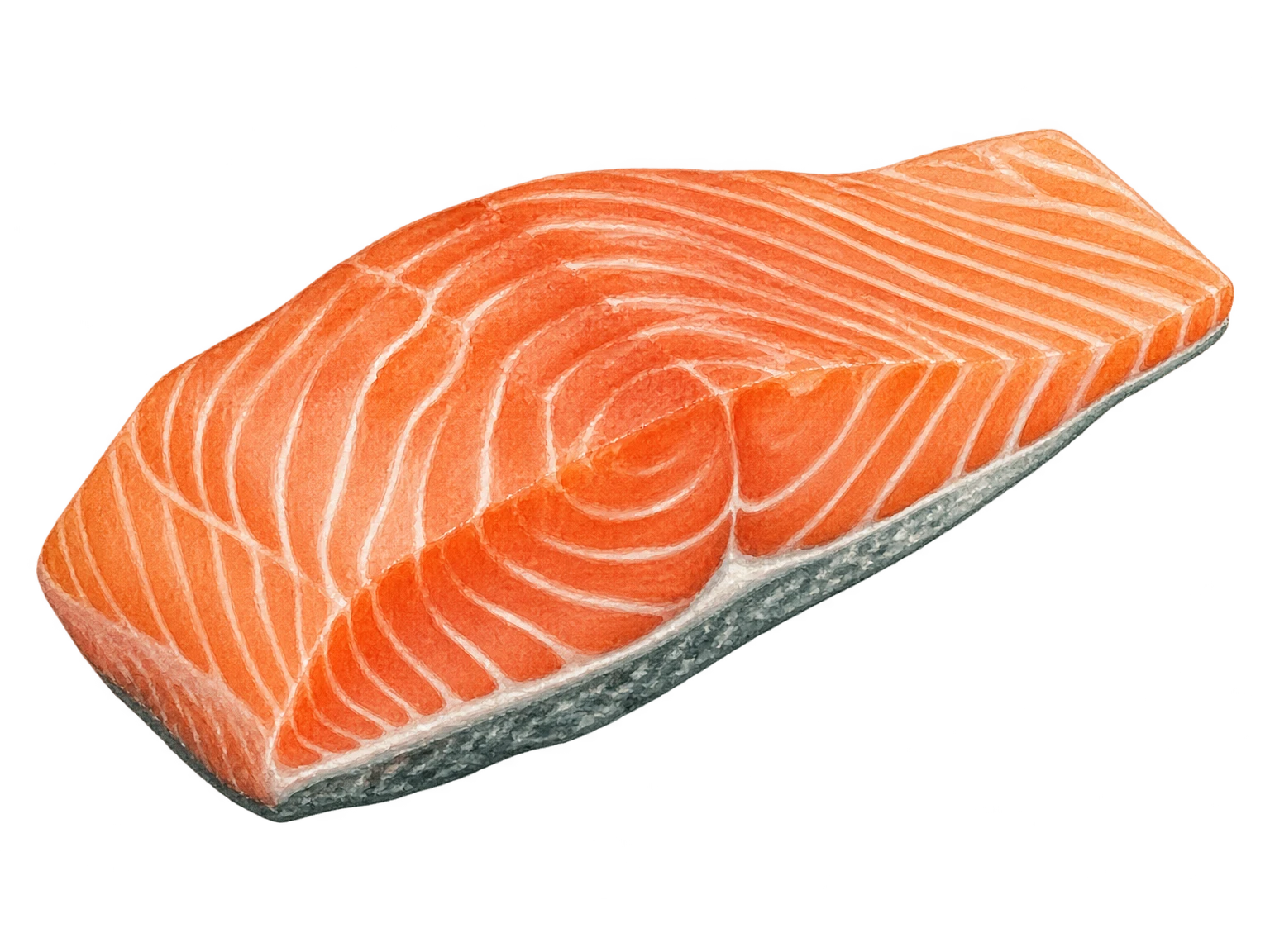
Salmon includes Atlantic salmon and several Pacific salmon species. Its tender flesh can be grilled, baked or steamed, while smoked salmon is often served with bread or in salads. Salmon is also used in sushi and sashimi. Species, farming conditions and preparation affect its nutrient composition. The table lists nutrient amounts per 100 g, together with the relevant source.
Salmon: species and ways to enjoy it
Salmon includes Atlantic salmon and several Pacific salmon species. Its flesh is usually pink to orange. Salmon is an oily fish that provides protein and omega-3 fatty acids. It can be baked, grilled, pan-fried or steamed. Smoked salmon is often eaten with bread or in salads, while raw salmon is also used in sushi and sashimi.
The species, farming conditions and preparation affect salmon’s nutrient composition. The table gives values per 100 g of the salmon listed there.
Nutrients
- Calcium5.84 mgper 100 g[9]
- Iron0.48 mgper 100 g[9]
- Magnesium27.4 mgper 100 g[9]
- Phosphorus181 mgper 100 g[9]
- Potassium358 mgper 100 g[9]
- Zinc0.36 mgper 100 g[9]
- Iodine8.21 µgper 100 g[9]
- Selenium16.5 µgper 100 g[9]
- Vitamin A4.27 µgper 100 g[9]
- Vitamin E2.3 mgper 100 g[9]
- Vitamin D4.92 µgper 100 g[9]
- Vitamin C1.8 mgper 100 g[9]
- Vitamin B60.58 mgper 100 g[9]
- Vitamin B123.95 µgper 100 g[9]
- Vitamin K0.3 µgper 100 g[9]
- Folate20.8 µgper 100 g[9]
Safety information
Contraindication
Avoid salmon if you have a confirmed salmon allergy
Avoid salmon if you have a confirmed salmon allergy. Fish allergy can cause hives, swelling, vomiting and life-threatening anaphylaxis. Allergy to another fish species does not automatically mean salmon allergy; an allergy specialist should determine which species you need to avoid. [1]
Caution · Pregnant women
Thoroughly heat raw and smoked salmon during pregnancy
During pregnancy, eat raw, smoked or cured salmon, including gravlax, only after thorough heating. These products can contain Listeria, and infection can harm the pregnancy or newborn. BfR recommends at least 70°C at the centre for two minutes. Hot-smoked salmon is not automatically safe; thoroughly cooked salmon does not generally need to be avoided. [2][3]
Caution · Adults
Extra care for older adults and people with weakened immunity
If you are an older adult or have weakened immunity, including from medicines, eat raw, smoked and cured salmon only after thorough heating. Listeria can cause severe infections in these groups. BfR recommends at least 70°C at the centre for two minutes. [2]
Caution · Children (1–3 years)
Serve young children only thoroughly heated salmon
Do not give young children raw salmon, smoked salmon or gravlax unless it has been thoroughly heated. This precaution concerns foodborne infections; it is not a reason to avoid thoroughly cooked salmon. [4]
Caution
Raw salmon needs appropriate parasite control
If you eat salmon raw, use products suitable for raw consumption that have undergone the required parasite-control measures. The risk is very low for Atlantic salmon raised under suitable farming conditions, but this cannot be assumed for every farmed salmon product. [5]
Caution
Lower mercury does not mean contaminant-free
FDA/EPA classifies salmon as a lower-mercury fish. However, oily fish such as salmon can contribute to exposure to dioxins and dioxin-like PCBs, with levels depending on the product and its origin. A universal maximum amount of salmon cannot be derived without suitable contaminant measurements. [6][7]
Caution · Premenopausal women
UK guidance on oily-fish portions
The UK NHS advises women before menopause, including during pregnancy and breastfeeding, to eat no more than two portions of oily fish per week; a portion is about 140 g. Salmon counts towards this total. This applies to all oily fish combined and is national dietary guidance, not a formal tolerable upper intake level. Follow the advice applicable in your country. [8]
Frequently asked questions
Is salmon an oily fish?
Yes. Salmon is an oily fish.
Which omega-3 fatty acids does salmon contain?
Salmon is known for its omega-3 fatty acids.
How can salmon be prepared?
Salmon can be baked, grilled, steamed or smoked. It is also eaten raw in sushi or sashimi.
Which species of salmon are included?
Salmon includes Atlantic salmon (Salmo salar) and several Pacific salmon species (Oncorhynchus spp.).
Sources
- 01North West Allergy NetworkFish AllergyOpen source
- 02German Federal Institute for Risk Assessment (BfR)Invisible threat: listeria in smoked fishOpen source
- 03US Food and Drug Administration / US Environmental Protection AgencyQuestions & Answers from the FDA/EPA Advice about Eating Fish for Those Who Might Become or Are Pregnant or Breastfeeding and Children Ages 1 to 11 YearsOpen source
- 04German Federal Institute for Risk Assessment (BfR) · 2024Foodborne infections in private householdsOpen source
- 05European Food Safety AuthorityMany farmed fish parasite-free but more data neededOpen source
- 06US Food and Drug Administration / US Environmental Protection AgencyAdvice about Eating FishOpen source
- 07European Food Safety Authority · 2026EFSA confirms health concern from dietary exposure to dioxins and dioxin-like PCBs in EuropeOpen source
- 08National Health ServiceFish and shellfishOpen source
- 09ANSES – French Agency for Food, Environmental and Occupational Health & Safety – Ciqual French food composition table · 2025Salmon, raw, farmed (CIQUAL 26036)Open source