
Fruits
Orange
The orange is a juicy citrus fruit with a sweet to slightly tart flavour. It is usually eaten fresh or squeezed for juice and is particularly known for its vitamin C content.
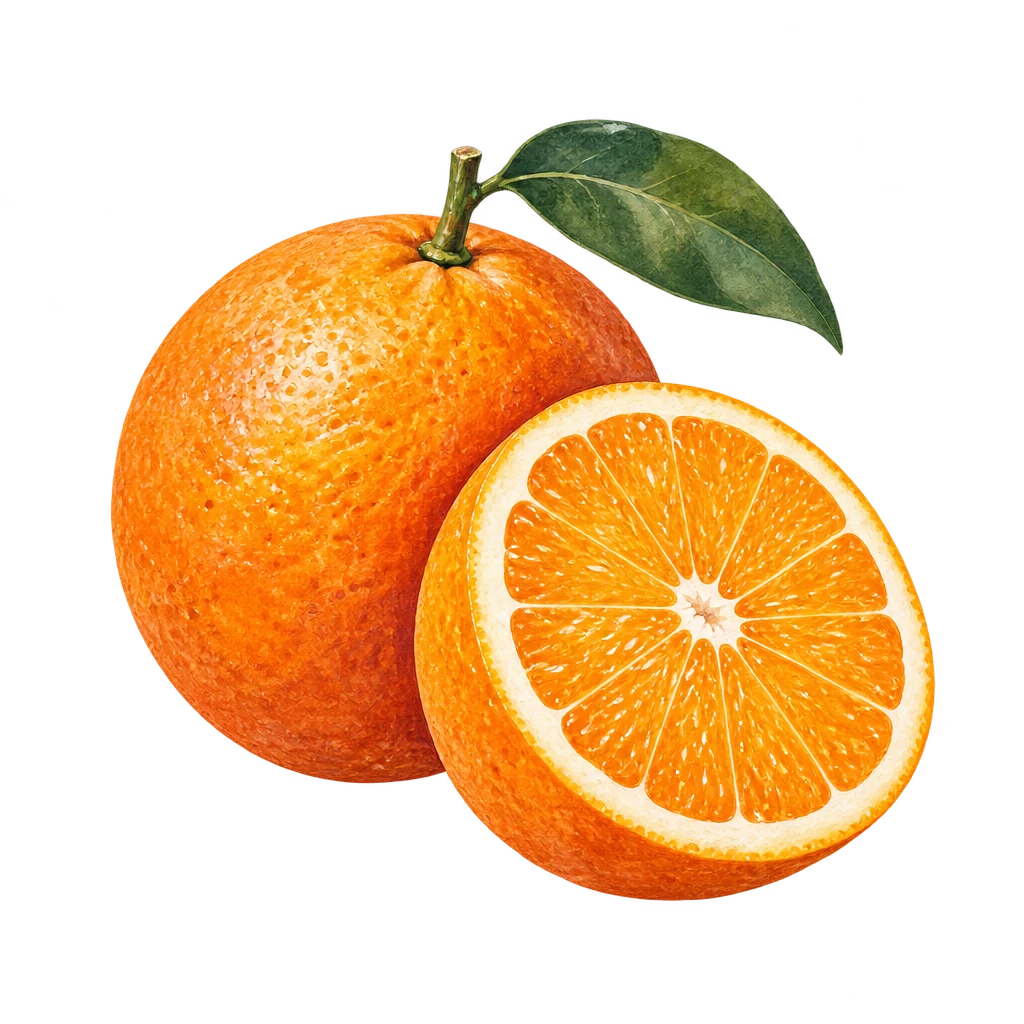
Oranges have an aromatic peel and juicy flesh divided into segments. You can eat them peeled as a snack, add them to fruit salads or use them in savoury dishes and desserts. For zest, use washed peel labelled as suitable for consumption. Alongside vitamin C, the flesh provides fibre; juice generally contains much less fibre. Nutrient amounts are listed per 100 g of the edible portion, with the source indicated.
What is an orange?
An orange is a citrus fruit with a sweet to slightly tart flavour. Its juicy flesh is divided into segments. You can peel and eat it fresh, add it to fruit salads, or use it in savoury dishes and desserts. The zest can also be used if the peel has been washed and is suitable for eating.
Orange juice and safety
Frequent sipping of orange juice can expose teeth to acids and sugars for longer. Have juice with a meal if possible, and do not hold it in your mouth. If you are prone to reflux, oranges or orange juice may trigger symptoms for you; there is no need to avoid them automatically, but pay attention to your own response.
Nutrients
- Dietary fibre2.7 gper 100 g[13]
- Calcium66 mgper 100 g[13]
- Iron0.57 mgper 100 g[13]
- Magnesium15 mgper 100 g[13]
- Phosphorus38 mgper 100 g[13]
- Potassium180 mgper 100 g[13]
- Zinc0.25 mgper 100 g[13]
- Copper0.04 mgper 100 g[13]
- Vitamin A0.21 µgper 100 g[13]
- Vitamin E0.19 mgper 100 g[13]
- Vitamin D0 µgper 100 g[13]
- Vitamin C47.5 mgper 100 g[13]
- Vitamin B120 µgper 100 g[13]
- Folate25.9 µgper 100 g[13]
Safety information
Contraindication
Avoid orange if you have a confirmed allergy
If you are allergic to orange, avoid it and follow your allergy action plan. Orange can trigger itching or swelling in the mouth in pollen-food syndrome. Breathing difficulty, marked throat swelling or collapse require immediate emergency help. Hay fever alone is not a reason to avoid oranges you tolerate. [1][2]
Side effect
A possible individual reflux trigger
If you have heartburn or reflux, orange or orange juice may worsen your symptoms. Evidence is inconsistent: routine avoidance is not justified, but reducing them is reasonable if they repeatedly trigger your symptoms. [3]
Caution
Orange juice: acid and sugar exposure for teeth
Frequent sipping of orange juice prolongs contact between teeth, acids and sugars and can contribute to dental erosion and decay. Have juice with a meal rather than sipping it throughout the day, and do not hold it in your mouth. This is not a reason to discourage ordinary whole-fruit consumption. [4][5]
Interaction
Orange juice and fexofenadine
If you take fexofenadine, do not drink orange juice: it can reduce absorption and effectiveness of the medicine. Take it with water and follow the leaflet or your pharmacist’s advice. [6]
Interaction
Do not take aliskiren with fruit juice
If you take aliskiren, such as Rasilez, do not take it with orange juice or other fruit juice. Juice can reduce absorption and may reduce effectiveness. Follow the administration instructions and do not change the dose yourself. [7]
Interaction
Calcium-fortified juice and ciprofloxacin
If you take oral ciprofloxacin, do not take it together with calcium-fortified orange juice. Added calcium can reduce absorption of the antibiotic. Follow the product-specific spacing instructions; this is not a blanket restriction on ordinary oranges. [8]
Caution
Individual advice if you have a potassium restriction
With kidney failure, high blood potassium or a prescribed potassium restriction, you may need to limit oranges and orange juice. Agree suitable amounts with your clinical team or renal dietitian using your blood results. Not everyone with kidney disease needs this restriction. [9]
Caution
Pay particular attention to juice portions with diabetes
If you have diabetes, whole oranges do not need to be excluded automatically. Orange juice can raise blood glucose quickly, so account for the portion in your eating plan. With gestational diabetes, your clinical team may recommend limiting or avoiding juice. [10]
Caution
Avoid untreated juice in vulnerable groups
If you are pregnant, older or immunocompromised, choose pasteurised or otherwise safely treated orange juice. This also applies to young children. Untreated juice can contain pathogens that cause serious foodborne illness; the risk concerns hygiene and processing, not inherent orange toxicity. [11]
Caution
No juice for infants under twelve months
Do not give orange juice or other fruit juice to infants under twelve months. This recommendation concerns juice and does not mean that age-appropriately prepared whole fruit is prohibited. [12]
Frequently asked questions
What is an orange?
An orange is a juicy citrus fruit with a sweet to slightly tart flavour.
Does an orange contain vitamin C?
Yes. Oranges are particularly known for their vitamin C content.
Does a whole orange provide fibre?
Yes. The flesh of an orange contains dietary fibre.
Which parts of an orange can you eat?
You can eat the flesh and drink the juice; the zest is also suitable for consumption.
More entries
Banana
A banana is the edible fruit of a plant in the genus Musa. It belongs to the fruit food group and is usually eaten fresh.

Sources
- 01Worcestershire Acute Hospitals NHS TrustOral allergy syndrome: patient informationOpen source
- 02NHSFood allergyOpen source
- 03Dietary and Lifestyle Factors Related to Gastroesophageal Reflux Disease: A Systematic ReviewOpen source
- 04UK GovernmentDelivering better oral health: Chapter 7, tooth wearOpen source
- 05UK GovernmentDelivering better oral health: Chapter 10, healthier eatingOpen source
- 06NHSAbout fexofenadineOpen source
- 07European Medicines AgencyRasilezOpen source
- 08NHSAbout ciprofloxacinOpen source
- 09National Institute of Diabetes and Digestive and Kidney DiseasesEating Right with Kidney FailureOpen source
- 10My Diabetes My Way, NHS ScotlandFruit and VegetablesOpen source
- 11US Food and Drug AdministrationWhat You Need to Know About Juice SafetyOpen source
- 12US Food and Drug AdministrationWhat You Can Do to Limit Exposure to Arsenic and Lead from JuicesOpen source
- 13ANSES – French Agency for Food, Environmental and Occupational Health & Safety – Ciqual French food composition table · 2025Orange, flesh without skin, without seeds, raw (CIQUAL 13034)Open source