Fruits
Banana
A banana is the edible fruit of a plant in the genus Musa. It belongs to the fruit food group and is usually eaten fresh.
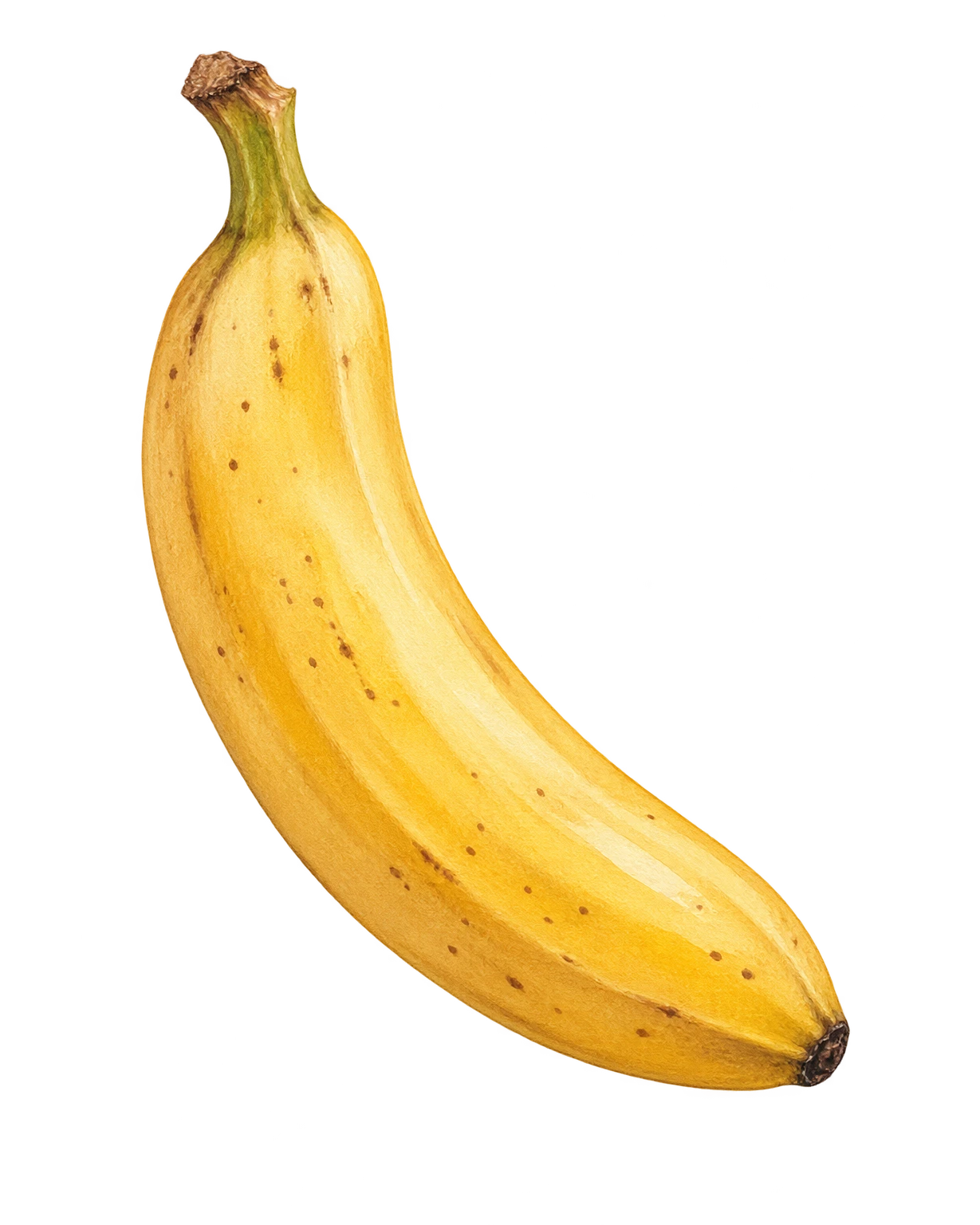
Bananas grow on large herbaceous plants in the family Musaceae, rather than on trees. Botanically, their fruits are berries. Many dessert bananas, including Cavendish cultivars, derive from Musa acuminata; other cultivated bananas have hybrid origins. You can eat them on their own or use them in fruit salads, smoothies and baking. Starchier plantains are usually cooked and should be recorded separately in a nutrition database. A banana is a whole food containing multiple constituents, not an individual nutrient.
Banana: nutrients, ripeness and possible effects
A banana is a fruit of the plant genus Musa. It grows on a large herbaceous plant rather than a tree and is botanically a berry. This page covers dessert bananas, which are usually eaten fresh. Starchier plantains are generally cooked and should be considered separately.
What is in a banana?
Bananas provide carbohydrates, fibre, potassium and vitamin B6, among other nutrients. The figures below are reference values from the Norwegian Food Composition Table. Variety, ripeness and origin can affect the actual composition.
What these nutrients contribute
Potassium contributes to normal muscle function, the normal functioning of the nervous system and the maintenance of normal blood pressure. Vitamin B6 contributes to normal energy-yielding metabolism and the normal functioning of the nervous system. These nutrient health claims are authorised under Commission Regulation (EU) No 432/2012. The Norwegian reference values for raw banana meet the conditions for a source of potassium and vitamin B6.
The claims describe normal nutrient functions, not a unique banana effect. They do not establish that bananas prevent muscle cramps, speed up metabolism or treat high blood pressure.
Why ripe bananas taste sweeter
As a banana ripens, starch in its flesh is broken down into sugars. This changes its carbohydrate composition and usually makes it taste sweeter. Ripeness alone cannot precisely predict an individual's blood glucose response.
Naturally occurring sugars in a whole fresh banana are not classified as free sugars under the WHO definition. This does not mean that bananas are sugar-free.
Do bananas help with constipation?
The evidence is limited. Systematic reviews describe a small study in children and adolescents with constipation in which cooked green-banana purée showed signs of improvement. Some intervention groups also received laxatives. This does not establish a benefit from ordinary ripe bananas or a benefit in healthy children or adults. Green-banana flours, powders and extracts are also not equivalent to ordinary banana flesh.
Bananas in everyday meals
You can eat bananas on their own or use them in fruit salads, smoothies and baking. Under NHS guidance, one banana counts as one fruit portion towards 5 A Day. Combine bananas with other fruits and vegetables for variety.
The reviewed sources do not establish an authoritative daily maximum for bananas. This does not mean unlimited amounts are safe for everyone; individual advice on potassium intake remains important.
How nutrition works
Blood pressure
Muscle function
Nervous system
Energy metabolism
Psychological function
Glycaemic control
Bowel regularity
Cooked green-banana preparations may improve some symptoms in children and adolescents with functional constipation, but the evidence is limited. [5]
Body weight
Statements & evidence
According to the Norwegian Food Composition Table, 100 g of raw banana provides 88 kcal, 19.7 g carbohydrate, 2 g fibre, 1.1 g protein and 0.2 g fat. [7]
These values refer to the edible portion without the peel. They are database values; variety, ripeness and origin can affect the actual composition.
The Norwegian Food Composition Table lists 348 mg potassium and 0.31 mg vitamin B6 per 100 g of raw banana. [7][2][1]
These values exceed the usual EU thresholds for a source of potassium and a source of vitamin B6 in solid foods: 300 mg and 0.21 mg per 100 g, respectively. This supports the use of the corresponding nutrient claims on this composition basis; eligibility must be checked for a specific product.
Vitamin B6 contributes to normal protein and glycogen metabolism. [1][2][7]
The claim is authorised for vitamin B6 and requires the food to be at least a source of vitamin B6. The Norwegian data for raw banana meet this condition. The authorisation does not establish a unique metabolic benefit of bananas compared with other suitable sources of vitamin B6.
Vitamin B6 contributes to the reduction of tiredness and fatigue. [1][2][7]
The claim concerns vitamin B6 and may only be used for foods that are at least a source of vitamin B6. The Norwegian composition data meet this condition. It does not promise that a single banana immediately relieves tiredness.
As a banana ripens, starch in its flesh is broken down into sugars. [8]
This changes the carbohydrate composition and usually makes the banana taste sweeter. Ripeness alone does not establish a precise individual blood glucose response.
Naturally occurring sugars in a whole fresh banana are not classified as free sugars under the WHO definition. [9]
This does not mean that bananas are sugar-free. WHO distinguishes sugars in whole fresh fruit from added sugars and sugars in honey, syrups, fruit juices and fruit juice concentrates.
Under NHS guidance, one banana counts as one fruit portion towards 5 A Day. [10]
This is practical portion guidance from a national dietary recommendation, not an EU health claim. You can combine bananas with other fruits and vegetables for variety.
The banana-specific health claim concerning antioxidant protection is not authorised in the EU. [11]
The archived EU Register lists the submitted claim as non-authorised because the claimed effect was not sufficiently substantiated. This does not establish that bananas contain no compounds with antioxidant activity; it limits the health claim that may be made.
Nutrients
- Potassium358 mgper 100 g[3]
- Magnesium27 mgper 100 g[3]
- Dietary fibre2.6 gper 100 g[3]
- Vitamin B60.367 mgper 100 g[3]
Safety information
Side effect
Allergic reactions
If you are allergic to banana, it can cause mouth itching, swelling or, rarely, severe reactions. Avoid banana if your allergy is confirmed and seek specialist advice. For breathing difficulty, substantial throat swelling or fainting, use prescribed adrenaline and call emergency services immediately. Cooking does not make banana safe for everyone with an allergy. [12][13][14]
Caution
Cross-reactions with latex allergy
If you have a latex allergy, you may also react to banana. This does not affect everyone with latex allergy and does not mean that everyone needs to avoid banana. Seek allergy assessment if you notice symptoms after eating it. [15]
Caution
Potassium with impaired kidney function
If your kidneys cannot excrete potassium adequately or your blood potassium is already high, potassium from bananas can contribute to a further rise. Agree an appropriate intake with your healthcare team based on your blood results. Kidney disease alone does not mean a universal banana ban; potassium from ordinary foods is generally not a concern with healthy kidneys. [16][17]
Interaction
Medicines that raise potassium
Potassium-sparing diuretics such as spironolactone or amiloride, ACE inhibitors and angiotensin-receptor blockers can raise blood potassium, particularly with impaired kidney function. If you take these medicines, ask your healthcare team whether your total potassium intake, including bananas, needs adjustment. This is not an automatic banana ban for everyone. [16]
Interaction
Banana peel when taking MAO inhibitors
If you take an MAO inhibitor that requires a low-tyramine diet, avoid banana peel and follow the dietary instructions for your medicine. Tyramine can cause a dangerous rise in blood pressure in this setting. This warning about peel should not be treated as a general ban on ordinary banana flesh. [18]
Upper level
No established daily upper limit
No authoritative daily maximum for bananas was identified in the reviewed sources. EFSA also could not establish a tolerable upper intake level for potassium because the evidence was insufficient. This does not mean unlimited intake is safe for everyone; individual advice remains important when blood potassium is high or potassium excretion is impaired. [19]
Caution
Green-banana products lack standardised safety data
Findings about ordinary banana flesh cannot automatically be applied to concentrated powders or extracts. Green-banana flours and other preparations differ substantially in their composition and the amounts studied, so a universal safe maximum cannot be derived. [20]
Caution
Age-appropriate preparation for babies
Banana can be offered as a complementary food from around six months when your baby is ready. Prepare it in a soft, developmentally appropriate form, such as soft finger-food sticks, and supervise your baby while eating. [21]
Frequently asked questions
What nutrients are in a banana?
Bananas provide carbohydrates, fibre, potassium and vitamin B6, among other nutrients. According to the Norwegian Food Composition Table, 100 g of raw banana without the peel contains 348 mg potassium and 0.31 mg vitamin B6.
Why do ripe bananas taste sweeter than green ones?
As a banana ripens, starch in its flesh is broken down into sugars, usually making it taste sweeter. Ripeness alone cannot precisely predict your blood glucose response.
Do bananas help with constipation?
The evidence is limited: a small study in children and adolescents with constipation found signs of improvement with cooked green-banana purée. This does not establish a benefit from ordinary ripe bananas or a benefit in adults.
Can bananas prevent muscle cramps?
The potassium in bananas contributes to normal muscle function. However, this authorised EU health claim does not establish that bananas prevent muscle cramps or improve sporting performance.
How many bananas can I eat a day?
The reviewed sources do not establish an authoritative daily maximum for bananas, but this does not mean unlimited amounts are safe for everyone. If your blood potassium is high or your kidneys cannot excrete potassium adequately, agree an appropriate amount with your healthcare team.
Related articles
Eating more fibre: step by step
How to increase your fibre intake slowly and practically – with whole grains, fruit and, if you like, psyllium husk.
Sources
- 01European Commission · 2012Commission Regulation (EU) No 432/2012 establishing a list of permitted health claims made on foods, other than those referring to the reduction of disease risk and to children's development and healthOpen source
- 02European Parliament and Council of the European Union · 2011Regulation (EU) No 1169/2011 on the provision of food information to consumersOpen source
- 03U.S. Department of Agriculture, Agricultural Research Service – FoodData Central · 2019Bananas, raw (FDC ID 173944, SR Legacy)Open source
- 04EFSA Journal · 2011Scientific Opinion on the substantiation of health claims related to resistant starch and reduction of post-prandial glycaemic responses (ID 681), “digestive health benefits” (ID 682) and “favours a normal colon metabolism” (ID 783) pursuant to Article 13(1) of Regulation (EC) No 1924/2006DOI 10.2903/j.efsa.2011.2024
- 052019Health Benefits of Green Banana Consumption: A Systematic ReviewOpen source
- 062024Green banana biomass anti-obesogenic, anti-hyperlipidemic, antidiabetic, and intestinal function potential effects: a systematic reviewPubMed 38630587Open source
- 07Norwegian Food Composition TableBanana, rawOpen source
- 08Food and Agriculture Organization of the United NationsChapter 2. Basic harvest and post-harvest handling considerations for fresh fruits and vegetablesOpen source
- 09World Health Organization · 2015WHO calls on countries to reduce sugars intake among adults and childrenOpen source
- 10NHSEating a balanced dietOpen source
- 11European CommissionEU Register of nutrition and health claims made on foods — archived registerOpen source
- 12Comprehensive Review on Banana Fruit Allergy: Pathogenesis, Diagnosis, Management, and Potential Modification of Allergens through Food ProcessingPubMed 35661960Open source
- 13NHSFood allergyOpen source
- 14Worcestershire Acute Hospitals NHS TrustPollen - Food SyndromeOpen source
- 152024Revisiting Latex-Fruit Syndrome after 30 Years of Research: A Comprehensive Literature Review and Description of Two CasesOpen source
- 16National Institutes of Health, Office of Dietary SupplementsPotassium - Health Professional Fact SheetOpen source
- 17NHSChronic kidney disease - Living withOpen source
- 18Torbay and South Devon NHS Foundation TrustFoods to avoid when taking Monoamine Oxidase Inhibitors (MAOIs)Open source
- 19Scientific Committee on Food; EFSA Scientific Panel on Dietetic Products, Nutrition and Allergies · 2006Tolerable Upper Intake Levels for Vitamins and MineralsOpen source
- 20Nutrients · 2019Health Benefits of Green Banana Consumption: A Systematic ReviewPubMed 31146437Open source
- 21NHSFruity sticks - Recipes - Best Start in LifeOpen source
- 22CREAAlimentiNUTrizione — Banane, frescheOpen source
- 23Bundeszentrum für Ernährung (BZfE)Exotische Frucht: BananeOpen source
- 24Royal Botanic Gardens, KewMusa acuminata Colla | Plants of the World OnlineOpen source
- 25New Zealand Food Composition DatabaseNew Zealand Food Composition Tables, Concise Tables, 14th edition — L1101: yellow, ripened, raw bananaOpen source
- 26European Journal of Pediatrics · 2024Role of green banana consumption in the treatment of acute and persistent diarrhea in children: a systematic review and meta-analysis of randomized controlled trialsDOI 10.1007/s00431-024-05679-0PubMed 38972965
- 27EFSA Journal · 2010Scientific Opinion on principles for deriving and applying Dietary Reference ValuesEFSA Panel on Dietetic Products, Nutrition and Allergies (NDA)DOI 10.2903/j.efsa.2010.1458
- 28EFSA Journal · 2010Scientific Opinion on the substantiation of health claims related to potassium and maintenance of normal muscular and neurological function (ID 320, 386) and maintenance of normal blood pressure (ID 321) pursuant to Article 13(1) of Regulation (EC) No 1924/2006DOI 10.2903/j.efsa.2010.1469